EEG waveforms, emotion quadrants, and neural network nodes
Emotion AIEEG classificationApplied ML portfolio

Machine Learning for Emotional State Classification

A hiring-focused showcase of an EEG affective-computing project: from noisy physiological signals to model comparison and interpretable results, with the larger question made explicit: why emotion-aware AI matters and where it could go next.

71-74%

neural network accuracy range

664

PCA components after reduction

4

emotion dimensions evaluated

The why

Emotion AI is important because the human state is part of the system

A lot of AI work optimizes the machine side of interaction: prediction, speed, automation, and output quality. This project looks at the harder human side: can a model detect useful emotional-state signals from messy physiology, and can we be honest about what the evidence does and does not support?

The practical value is not claiming to read minds.

The value is building AI systems that can reason about uncertainty, adapt to human context, and avoid treating people like identical input devices.

Emotion is a hidden state

Most software treats emotional state as something users must type, click, or explain. EEG-based affective computing asks whether physiological signals can help systems notice workload, engagement, or stress without relying only on self-report.
The problem is genuinely hard

EEG is weak, noisy, person-specific, and easy to overclaim. That makes it a useful test bed for practical AI judgement: preprocessing, baselines, evaluation design, and honest communication matter as much as model choice.

It connects AI to human context

If handled responsibly, emotion-aware models can support adaptive learning, assistive interfaces, human-robot interaction, and wellbeing research. The point is not mind reading; it is better human-centred feedback loops.

What it can lead to

Useful directions if the evidence gets stronger

The path from notebook to product needs validation, consent, and calibration. These are plausible directions, not claims of deployment readiness.

Adaptive interfaces

Tools that adjust pacing, difficulty, or intervention timing when signals suggest overload or disengagement.

Better human-robot interaction

Robots or agents that respond to affective context instead of treating every interaction as emotionally neutral.

Biofeedback and research tools

Dashboards for studying attention, arousal, or recovery patterns, with consent and clear limits around interpretation.

Responsible affective AI practice

A way to discuss ethics, privacy, calibration, and uncertainty before deploying models around sensitive human signals.

For AI hiring teams

What this project demonstrates

The useful signal is not just the final score. It is the ability to frame an ambiguous data problem, choose defensible baselines, and explain where model performance is limited by the data.

Can handle messy data

EEG is noisy, high-dimensional, and variable across people. The project shows practical preprocessing and evaluation discipline.

Can compare models honestly

The work does not just present a neural network. It benchmarks simpler models and explains why they underperform.

Can communicate technical tradeoffs

The report connects model results to constraints hiring teams care about: data quality, scaling, interpretability, and generalisation.

ML workflow

From physiological data to usable model evidence

The project moved through dataset selection, EEG preprocessing, feature extraction, dimensionality reduction, and comparative supervised learning.

Feature engineering

Dimensionality reduction

PCA retained 90% of variance while reducing the feature set to 664 components for more practical modelling.

DEAP

32 EEG channels, 21.3 hours of data, plus peripheral signals and emotion ratings.

DREAMER

14 EEG channels, consumer-grade headset data, and a separate notebook prototype.

DREAMER notebook

2,132

Rows

2,548

Features

3

Classes

2.15M

GRU params

The notebook used a Keras GRU prototype, 70/30 split, sparse categorical cross-entropy, and early stopping.

Dataset examples

What a training example represents

The raw dataset is not a simple table of feelings. Each example is a structured measurement: a stimulus window, many EEG channels, extracted signal features, and emotion labels created from human ratings.

Main report dataset

One DEAP trial

DEAP

A participant watches an affective video stimulus while EEG and peripheral signals are recorded. The trial is then paired with self-reported emotion ratings that become the supervised learning target.

Channels

32 EEG channels plus peripheral signals

Window

Video stimulus window, then rating

Label

Valence, arousal, dominance, liking

Example EEG signal sketch

normalized

Stimulus
EEG window
Ratings

Channel map

32 nodes

Label space

high arousalpositive valence

Feature view

Alpha power66%
Beta power82%
PSD74%
Differential entropy58%

32

EEG channels

21.3h

Recorded data

4

Targets

664

PCA features

pleasant

Valence

activated

Arousal

high

Dominance

positive

Liking

Model comparison

Neural networks led, but the baselines matter

Results are from the current report table for DEAP, organized by classifier and emotion dimension.

Neural Network on Valence

71.01%

Accuracy

73.45%

Precision

76.35%

Recall

74.87%

F1

Best overall performer across emotional dimensions, validating nonlinear modelling for high-dimensional EEG features.

Neural Network74.87% F1
SVM72.25% F1
LR71.69% F1
DT71.16% F1

Potential future work

What the next version should prove

The current report is clear about limitations: unimodal EEG has generalisation constraints, Dominance and Liking are less reliable than Valence and Arousal, and richer architectures would be needed for robust temporal modelling. The next stage should turn those limits into explicit tests.

Validate across people

Stronger generalisation evidence

Move beyond random row splits by holding out entire participants. That would test whether the model transfers to someone it has never seen.

Fuse more signals

More robust affect estimation

Combine EEG with facial expression, peripheral physiology, or interaction context so the system is not forced to infer everything from one noisy modality.

Model time directly

Better use of signal dynamics

Use LSTMs, temporal CNNs, transformers, or self-supervised EEG representations to learn how emotional state changes through the trial.

Add uncertainty and consent layers

Safer product path

Expose confidence, calibration, opt-in boundaries, and failure modes before any real-time affective interface is considered.

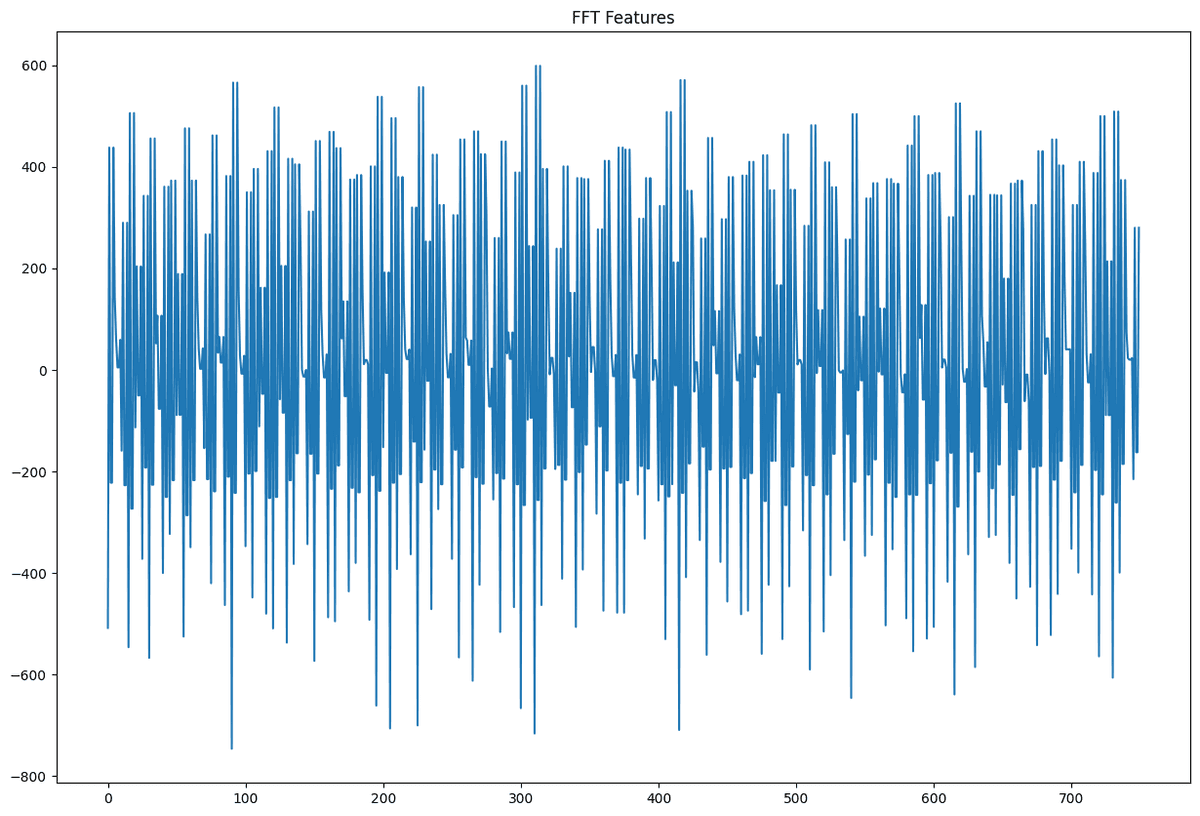
FFT feature plot from the EEG classification notebook
Notebook artifact: FFT feature visualization used while exploring frequency-domain EEG features.

The bigger research arc

A stronger version would not just chase a higher score. It would ask whether affective signals remain useful across new people, new tasks, new sensors, and real-time constraints, while making uncertainty visible to users.